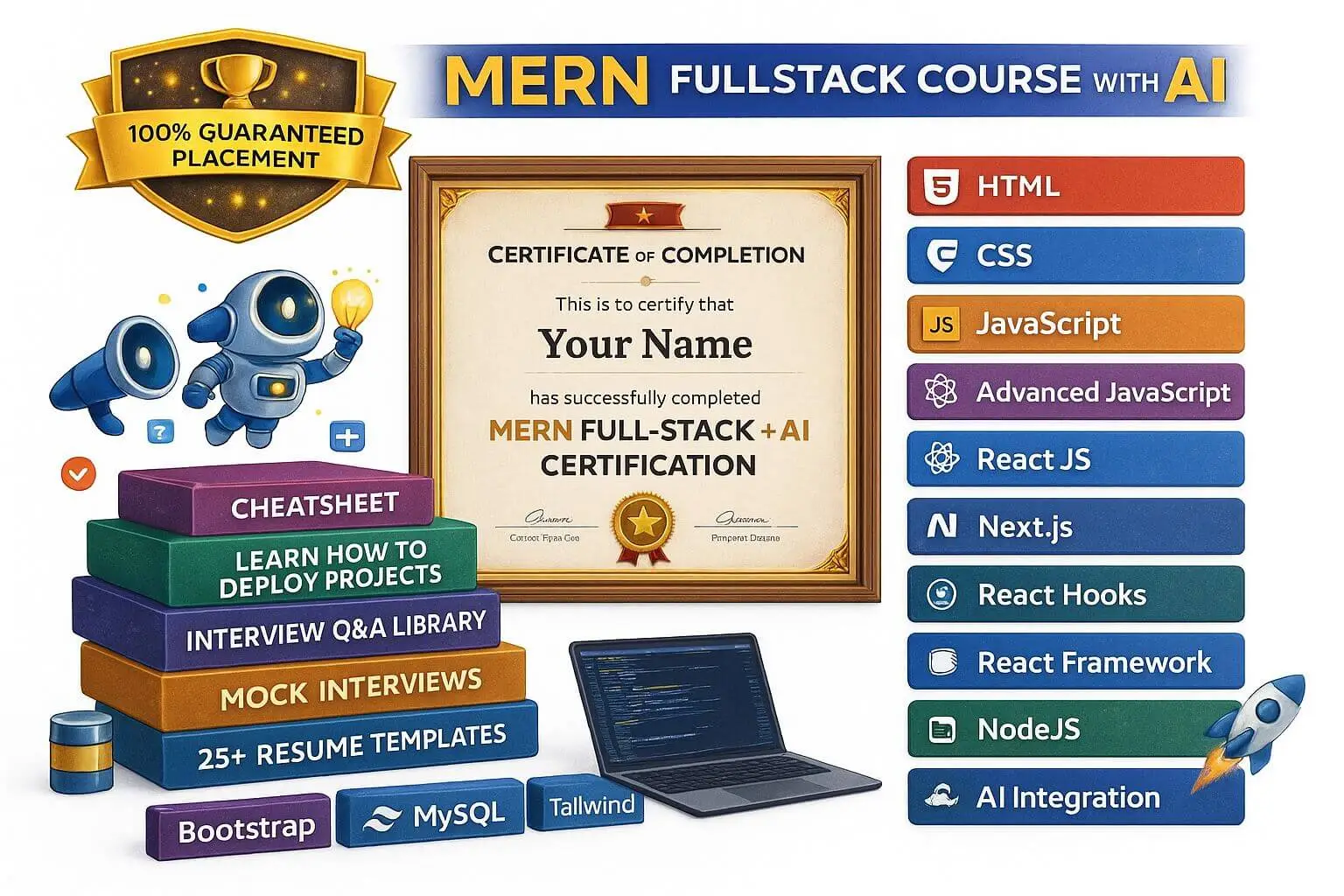
MERN Full Stack AI Developer Training
What you'll learn
- Master Full-Stack Web Development with MERN
- Become a Strong JavaScript Developer
- Build Modern Front-End Applications
- Develop Production-Ready Back-End Applications
- Work with MongoDB & NoSQL Databases
- Build Secure Authentication & Authorization Systems
- Build Real-World APIs & Integrations
- Learn Python for AI & Automation
- Understand Machine Learning Fundamentals
- Explore Deep Learning & NLP
- Master Generative AI & LLM Applications
- Learn Professional Prompt Engineering
- Build Production-Ready RAG Applications
- Build AI-Powered Knowledge Assistants
- Develop AI Agents & Agentic AI Applications
- Build Multi-Step AI Workflows
- Automate Business Processes with AI & n8n
- Combine MERN + AI to Build Intelligent Applications
- Deploy AI & Full-Stack Applications on AWS
- Build Industry-Oriented Capstone Projects
- Learn the Complete Application Development Lifecycle
- Build a Professional AI + Full-Stack Portfolio
- Prepare for Real-World Developer Roles
- Become Job-Ready as a Full-Stack AI Developer
Our Training Process

Practical Session

Assignment

Projects

Resume Building

Interview Preparation

Be Job Ready

Practical Session

Assignment

Projects

Be Job Ready

Interview Preparation

Resume Building
Key Highlights
- Personalised career coach
- 90% Practical Training
- Certification
- 100% Job Guaranteed
- Study material
- Instant doubt solving
- Mock Interviews
- Case studies and Live Projects

250 Hrs
Training Duration

25000+
Students Trained

1000+
Hiring Companies

12.5 LPA
Highest Fresher Salary
MERN Full Stack AI Developer Training
- Introduction to HTML
- HTML Elements
- HTML Table
- HTML Forms
- HTML5 Features
- Introduction to CSS
- Sizing Properties
- CSS Box Model
- Border property
- Background property
- Float
- Overflow property
- Visibility property
- Display property
- Flex property
- Gradients & Multiple Backgrounds
- Position property
- Transformation, Transitions and Animations
- Grid
- Media Queries
- Professional Proejcts
- Basics Of Bootstrap
- Bootstrap Grid System
- Bootstrap Layout
- Bootstrap Content
- Working with Forms
- Operators
- Bootstrap Components
- Accordion
- Alerts
- Carousel
- Drop-down
- Modal
- Nav and Tabs
- Modal
- Navbar
- Offcanvas
- Popovers
- Toasts, tooltips, scrollspy, Spinners
- Helpers
- Utilities For functionality
- For managing content
- Basics Of Tailwind CSS
- Installation of Tailwind CSS
- Layout
- Spacing
- Sizing
- Flexbox and Grid
- Typography
- Backgrounds
- Borders
- Effects
- Filters
- Tables
- Transitions and Animations
- Transform
- Interactivity
- Tailwind Content & styles
- Navigation
- Component
- Forms
- Data
- Helpers
- Design Blocks For functionality
- Introduction to Javascript
- Varibales
- Datatypes
- Popup Boxes
- Built-in-functions
- Functions
- DOM
- Operators
- Math Methods
- String methods
- Conditional Statements
- Function with parameter
- Arrays and Objects
- Nested Array and Objects
- Array methods
- Loops
- Nested Loops
- Break and Continue
- Events
- Components
- Timing Functions
- DOM Elements
- Built-in-objects
- JavaScript Form Validation
- Projects & Assignments
- The let keyword
- The const keyword
- Arrow Functions
- Spread and Rest Operator
- String and Object Literals
- Optional Chaining
- Default Parameter
- Array and Object Destructuring
- Array Methods
- array.filer()
- array.find()
- array.map()
- array.findIndex()
- array.reduce
- array.foreach()
- JavaScript Classes and Objects
- Callback Function
- JavaScript Hoisting
- Closure
- Session storage and Local Storage
- AJAX
- API Fetching
- Promises
- Promise methods
- ASYNC / Await
- Fetch method
- Projects & Assignments
- Getting started with React
- Components
- React hooks
- Props in react
- Routing
- Frontend designing with react
- Forms
- State management
- Keys in react
- Advanced Topics
- Projects & Assignments
- Getting started with Next.js
- App Routing
- Layouts and Templates
- Routing in Next.js
- Next.js Component
- Server-side Component and Client-side Component
- Data Fetching Methods
- Styling
- Static Assets and Optimizations
- Introduction to Javacript on server & Node.js
- Events and callbacks in Node js
- Modules/Packages
- Network Communication & Web Technolog
- Events and In build modules of node js and it working
- Babel and modern javascript with es6+ syntaxes
- API and HTTP methods
- Projects & Assignments
- Introduction to Express Framework
- What is express
- Installation and setup of node js using express
- Modules
- Routing
- Middleware
- Controllers
- Introduction
- String manipulation
- Data Structures
- Control loops
- Functions
- Object Oriented Programming
- Modules and packages
- Exception Handling
- Variabless
- PEP8
- Advanced concepts
- Application Programming Interface (API)
- Introduction to Machine Learning
- Introduction to Data Science
- Database
- REST APIs
- Async APIs
- JWT auth
- Pydantic
- Swagger docs
- AI API integrations
- Introduction to database
- Introduction to MongoDB
- Understanding MongoDB and nosql database
- Installing MongoDB
- Writing CRUD queries in mongoshell
- Models
- Intoduction and Understanding models in Express and node.
- Installing mongoose package to connect with MongoDB
- Writing queries through api for CRUD operations in MongoDb
- Evolution of Generative AI: From ML to LLMs
- Generative AI vs AI Agents vs Agentic AI
- Open Source vs Closed Source models
- Transformer architecture: Attention, encoder-decoder, self-attention
- Learn the architecture of Transformers like GPT & BERT
- Prompt engineering
- Understanding Chat, Completion, and Instruction-tuned models
- Prompt Engineering techniques: Few-shot, zero-shot, chain-of-thought
- Explore LLM providers: Gemini, Open AI, Hugging Face, LLAMA
- OpenAI API: Usage, tokens, parameters
- API integration with Python
- Fine-Tuning & Customizing LLMs
- Instruction tuning using domain-specific data
- Use case: Creating a healthcare/legal/HR domain assistant
- Best practices & deployment considerations
- Why RAG
- Ingestion: PDF, DOCX, HTML, tables, scanned documents (OCR), metadata extraction
- Chunking Strategies: fixed-size, recursive, semantic, parent-document, table-aware — and how to choose
- Embedding Models: Dimensions
- Text chunking, embedding models, similarity search
- Use cases: Document Q&A, PDF bots, private chatbots
- Combining LLMs with external knowledge
- What is a Vector DB
- Choosing the right Vector DB (FAISS vs Pinecone vs Weaviate)
- Generate vector embeddings using OpenAI or Hugging Face
- How embedding models work
- Storing, indexing, and retrieving large document
- FAISS, Chroma, Qdrant, Pinecone, Weaviate, ; selection criteria;
- Index types (Flat, HNSW, IVF) and the recall/latency trade-off.
- Similarity metrics (cosine, dot, L2)
- Metadata filtering and namespace design
- Retrieval quality: top-k tuning, hybrid search (BM25 + dense), re-ranking with cross-encoders / Cohere Rerank
- Query rewriting, multi-query
- Self-query, citation and source attribution
- What is an AI Agent?
- LangChain Agent architecture
- Adding tools: search, calculator, DB access, email
- Memory integration: BufferMemory, SummaryMemory
- Build chatbots that reason and act
- Introduction to LangGraph for stateful workflows
- Nodes, edges, state sharing
- Multi-agent collaboration (e.g., PM → Dev → Analyst agents)
- Conditional workflows, retries, and dynamic decision-making
- Use cases: Autonomous workflows, research agents, AI coworkers
Applications
- FastAPI / LangServe to deploy your solution as an API
- Build UIs using Streamlit / Gradio
- Deployment platforms: Vercel, AWS, Streamlit Cloud
- Logging, monitoring, human-in-the-loop workflows
- AWS APP Services
- CI/CD Boards, Repos
- GitHub Source Control
- App Deployment EC2
- Serverless Application
- Store Docker Images
- Kubernetes Services
- ML Development & Deployment
- Secrets Management
- Object Storage
- LLM Models in the cloud
- RAG & Semantic Search
- Log analysis
- Application performance monitoring
- Authentication (API keys, JWT, OAuth basics)
- secrets management (env vars, AWS Secrets Manager, never in Git)
- Input validation
- Output sanitisation
- Rate limiting and quotas
- CORS
- Audit logging
- Tenant isolation
- Token accounting
- Prompt compression
- Model routing (cheap model first, escalate on failure)
- Response caching
- Semantic caching
- Batching
- Streaming to reduce timeout waste
- Context trimming
- Human-in-the-loop review queues
- Enterprise Knowledge Copilot with RAG & Agentic AI
- AI-Powered Call Center Intelligence Platform
- Enterprise SOP Intelligence & Automation Platform
- AI-Powered Clinical Research Knowledge Agent
- Intelligent Loan Underwriting & Risk Assessment System
- Fraud Investigation & Financial Crime Intelligence Copilot
- Autonomous E-Commerce Shopping Assistant
- Agentic Supply Chain Planning Assistant
- Predictive Maintenance Intelligence & Action Agent
- AI Recruitment Workflow Automation Platform
Master 35+ Paid tools, including AI Powered Platforms
Skills you will gain
Course Certification
This global certificate serves as an official badge of your successful MERN Full Stack Developer training course completion, highlighting your expertise.
Students Reviews
Bhavana Rajak
Full Stack Developer
Jitesh
Full Stack Developer
Nilay
Full Stack Developer
Aditya Mali
Full Stack Developer
Genuine reviews for our MERN Full Stack AI Developer Training
Aditya Mali
Full Stack Developer
Posted on
Shagufta Khan
Full Stack Developer
Posted on
Bhagyashri Gunjate
Full Stack Developer
Posted on
Bhagyashri Gunjate
Full Stack Developer
Posted on
Divya Sharma
Full Stack Developer
Posted on
Divya Sharma
Full Stack Developer
Posted on
Hrishikesh Netke
Full Stack Developer
Posted on
Zagesh Rathod
Full Stack Developer
Posted on
Software Developer
Posted on
Software Developer
Posted on
Software Developer
Posted on
Student's Portfolio
Success Stories
Frequently Asked Questions (FAQs)
What is the duration of the course?
The MERN Full Stack Developer training course has a total duration of approximately 6 months. Throughout the course, you will receive hands-on practical training in each technology, with a focus on completing real-world projects. Following your training, we will prepare you for job interviews and facilitate job placement.
Is there 100% Placement Guarantee after the course is over?
Yes, we provide 100% placement guarantee in our MERN Full Stack Developer training course in Mumbai.
Are there any prerequisites before starting MERN Full Stack Developer Training?
No previous coding experience needed. All you need is a web browser and a code editor (we will download a free editor together)
Who teaches MERN Full Stack?
At TryCatch Classes, our team consists of seasoned experts with over 15 years of experience. A skilled MERN Full Stack Developer will be guiding students, encouraging them to ask questions without hesitation, and enabling us to effortlessly address all your inquiries.
Is the course Online or Offline?
This MERN Full Stack course is available offline & online both. You may choose whatever is feasible for you.
Offline course can be done at our Borivali Branch in Mumbai.
Online Live Course can be done on Zoom.
Who can learn MERN Full Stack?
This course is designed for everyone, even if you’re studying Commerce, Arts, or Mechanical subjects, or if you’re still in school. It doesn’t matter what your background is, you can definitely learn this course.
What software and tools do I need for this course?
All the tools required for this training will be installed during the course
Will I receive a certificate upon course completion?
Upon completion of the course, you will receive an official global MERN Full Stack certificate. This certificate serves as an official badge of your successful course completion, highlighting your expertise.
Can I interact with instructors and ask questions during the course?
Absolutely! Our instructors are always available to answer all your questions and solve your doubts.
Are there any real-world projects or case studies in the course?
Yes, we incorporate real-world projects and case studies into the course to help you apply what you’ve learned in practical scenarios.
Is there a money-back guarantee if I’m not satisfied with the course?
We offer a satisfaction guarantee. If you are not satisfied with the course within a specified timeframe, you can request a refund.
Shoutout from Arjun Kapoor
and Vidya Balan
Here's everything you're going to get
- 100% Guaranteed Placements
- Easy-to-follow modules
- Study Material
- Tutorials
- Interview Q&A Library
- Industry Oriented LIVE Projects
- Mock Interviews
- Access to Private Jobs Group
- Be Job Ready