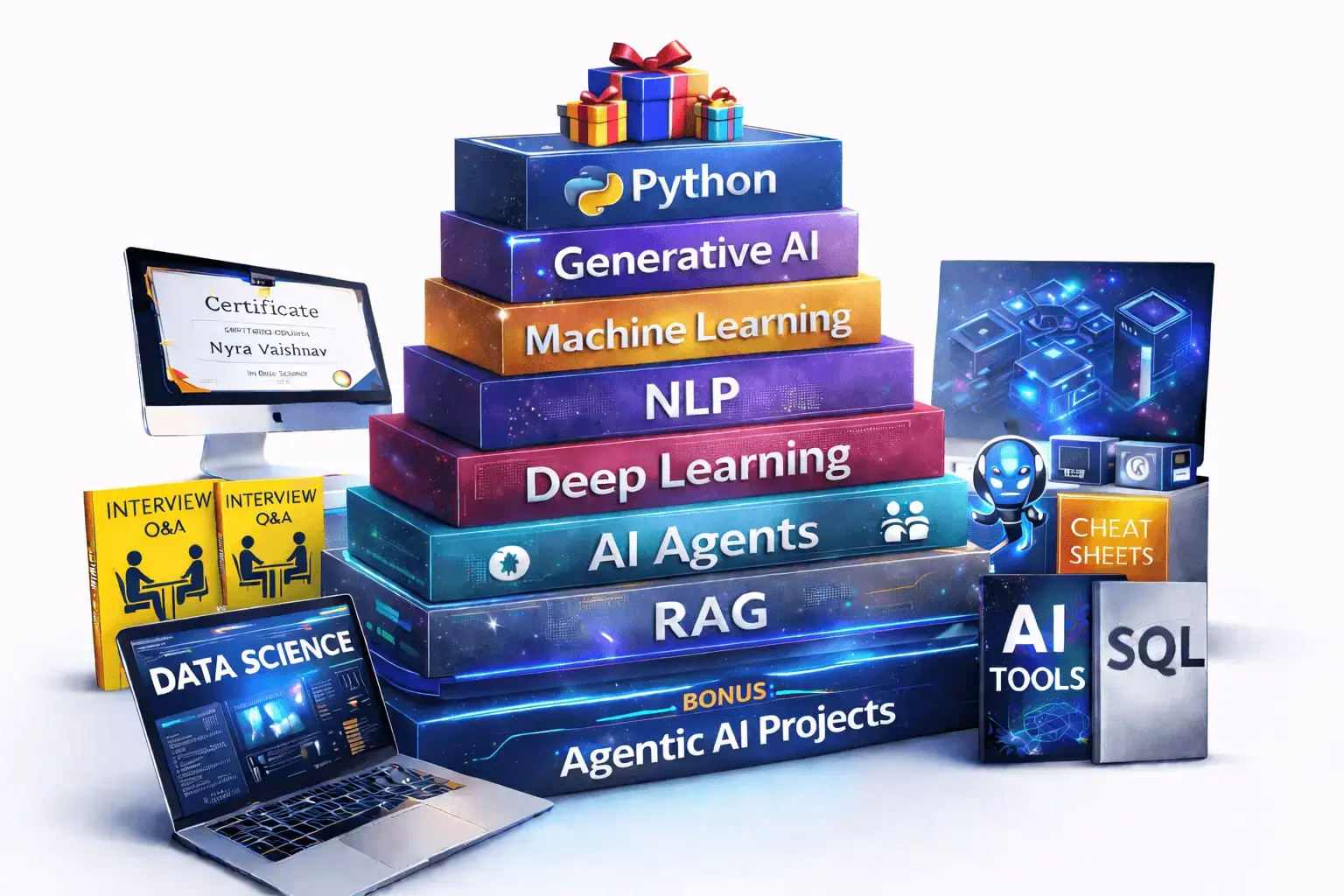
Data Science Training
What you'll learn
- Python programming from scratch — variables to OOP, NumPy, and Pandas, designed for students from non-IT backgrounds.
- Statistics & Exploratory Data Analysis — the maths behind every model, taught with real datasets, Matplotlib, and Seaborn.
- Machine Learning end to end — regression, classification, clustering, ensemble methods, and how to pick the right model for each business problem.
- Deep Learning with TensorFlow & Keras — ANNs, CNNs, and RNNs, plus transfer learning on real image and text data.
- Generative AI & LLMs — prompt engineering, LangChain, Hugging Face, and building applications with GPT and Gemini APIs.
- NLP & Chatbots — tokenization to sentiment analysis, ending with a working chatbot you can demo in interviews.
- SQL, Power BI & Tableau — query, model, and visualize data the way analytics teams do in industry.
- AWS Cloud for Data Science — deploy your work with S3, EC2, and managed analytics services.
- A hire-ready project portfolio — customer segmentation, a recommender system, and a chatbot, built as capstone projects.
Our Training Process

Practical Session

Assignment

Projects

Resume Building

Interview Preparation

Be Job Ready

Practical Session

Assignment

Projects

Be Job Ready

Interview Preparation

Resume Building
Key Highlights
- 100% Job Placement Guarantee
- Personalised career coach
- 90% Practical Training
- Official Certification
- Live Capstone Projects
- Study material
- Instant doubt solving
- Case studies and Projects

245 Hrs
Training Duration

25000+
Students Trained

1000+
Hiring Companies

8.5 LPA
Highest Fresher Salary
Data Science Training
Python Fundamentals
- Python Basics: Syntax, Variables, Data Types
- Input and Output Operations
- Operators and Expressions
- Conditional Statements
- Loops
- Data Structures: Lists, Tuples, Sets, Dictionaries
- Comprehensions and Iterations
- Hands-On Exercises: Scripts, condition checks, sorting data, dictionary
- Reading & Writing Files
- CSV Parsing
- Error Handling
- NumPy Arrays & Operations
- Indexing, Slicing, Reshaping
- Mathematical & Aggregation Functions
- Multi-Dimensional Arrays
- Hands-On Exercises: File parsing, CSV analytics, NumPy statistics
- Pandas DataFrames & Series
- Loading Data (CSV, Excel, SQL)
- Filtering, Sorting, Grouping
- Handling Missing Data
- Data Cleaning & Transformation
- Date & Time Handling
- Merging & Joining DataFrames
- Hands-On Exercises: Sales analysis, data cleaning, merging datasets
- Descriptive Statistics
- Matplotlib & Seaborn Visuals
- Correlation Analysis
- Outlier Detection
- Advanced Visualizations
- Multi-Panel Charts
- Hands-On Exercises: EDA reports, heatmaps, dashboards
- SQLAlchemy Basics
- ORM Queries
- SQL to Pandas Integration
- Writing Data Back to Databases
- Views, Stored Procedures, Optimization
- Hands-On Exercises: Database analytics & reporting
- Univariate, Bivariate & Multivariate Analysis
- Distributions & Probability
- Hypothesis Testing
- Confidence Intervals
- Correlation & Covariance
- Inferential Statistics
- Hands-On Exercises: Statistical analysis using real datasets
- ML Concepts & Use Cases
- Supervised vs Unsupervised Learning
- Regression & Classification
- Forecasting
- Hands-On Exercises: Churn analysis & fraud analysis
- Regression modeling
- Feature scaling
- Model evaluation
- K-Means clustering
- Hands-On: House price prediction, model optimization
- Linear & logistic regression
- Decision trees & random forests
- SVM, KNN
- PCA & LDA
- Hands-On: Stock prediction, customer segmentation
- Neural networks
- TensorFlow & PyTorch setup
- Tensors & computation graphs
- Basics of building and training models
- Hands-On: Build basic neural networks, Visualize computation graphs in TensorFlow
- Artificial Neural Networks (ANN)
- Convolutional Neural Networks (CNN)
- Recurrent Neural Networks (RNN)
- Transfer learning
- Hands-On: ANN, CNN & RNN implementations
- Long Short-Term Memory Networks (LSTM)
- Graph Neural Networks (GNN)
- Advanced Recurrent Architectures: Bidirectional RNN, GRU
- Hyperparameter tuning
- Hands-On: Time-series & graph models
- Introduction to NLP concepts
- Text preprocessing
- Tokenization & stemming
- NLTK
- Text classification
- Sentiment analysis
- Hands-On: Spam & sentiment models, Preprocess a text dataset using NLTK, Build a text classification model, Experiment with a text generation model
- Evolution of Generative AI: From ML to LLMs
- Generative AI vs AI Agents vs Agentic AI
- Open Source vs Closed Source models
- Transformer architecture: Attention, encoder-decoder, self-attention
- Learn the architecture of Transformers like GPT & BERT
- Prompt engineering
- Understanding Chat, Completion, and Instruction-tuned models
- Prompt Engineering techniques: Few-shot, zero-shot, chain-of-thought
- Explore LLM providers: Gemini, Open AI, Hugging Face, LLAMA
- OpenAI API: Usage, tokens, parameters
- API integration with Python
- Fine-Tuning & Customizing LLMs
- Instruction tuning using domain-specific data
- Use case: Creating a healthcare/legal/HR domain assistant
- Best practices & deployment considerations
- Why RAG
- Ingestion: PDF, DOCX, HTML, tables, scanned documents (OCR), metadata extraction
- Chunking Strategies: fixed-size, recursive, semantic, parent-document, table-aware — and how to choose
- Embedding Models: Dimensions
- Text chunking, embedding models, similarity search
- Use cases: Document Q&A, PDF bots, private chatbots
- Combining LLMs with external knowledge
- What is a Vector DB
- Choosing the right Vector DB (FAISS vs Pinecone vs Weaviate)
- Generate vector embeddings using OpenAI or Hugging Face
- How embedding models work
- Storing, indexing, and retrieving large document
- FAISS, Chroma, Qdrant, Pinecone, Weaviate, ; selection criteria;
- Index types (Flat, HNSW, IVF) and the recall/latency trade-off.
- Similarity metrics (cosine, dot, L2)
- Metadata filtering and namespace design
- Retrieval quality: top-k tuning, hybrid search (BM25 + dense), re-ranking with cross-encoders / Cohere Rerank
- Query rewriting, multi-query
- Self-query, citation and source attribution
- What is an AI Agent?
- LangChain Agent architecture
- Adding tools: search, calculator, DB access, email
- Memory integration: BufferMemory, SummaryMemory
- Build chatbots that reason and act
- Introduction to LangGraph for stateful workflows
- Nodes, edges, state sharing
- Multi-agent collaboration (e.g., PM → Dev → Analyst agents)
- Conditional workflows, retries, and dynamic decision-making
- Use cases: Autonomous workflows, research agents, AI coworkers
Applications
- FastAPI / LangServe to deploy your solution as an API
- Build UIs using Streamlit / Gradio
- Deployment platforms: Vercel, AWS, Streamlit Cloud
- Logging, monitoring, human-in-the-loop workflows
- AWS APP Services
- CI/CD Boards, Repos
- GitHub Source Control
- App Deployment EC2
- Serverless Application
- Store Docker Images
- Kubernetes Services
- ML Development & Deployment
- Secrets Management
- Object Storage
- LLM Models in the cloud
- RAG & Semantic Search
- Log analysis
- Application performance monitoring
- Authentication (API keys, JWT, OAuth basics)
- secrets management (env vars, AWS Secrets Manager, never in Git)
- Input validation
- Output sanitisation
- Rate limiting and quotas
- CORS
- Audit logging
- Tenant isolation
- Token accounting
- Prompt compression
- Model routing (cheap model first, escalate on failure)
- Response caching
- Semantic caching
- Batching
- Streaming to reduce timeout waste
- Context trimming
- Human-in-the-loop review queues
- Intelligent Agentic Ai Personal Assistant
- Build an Enterprise RAG Knowledge Assistant and a Multi-Agent Research Platform
- Customer Support App
- AI Resume Analyser
- Product Recommendation System for Ecommerce
- Social Media Sentiment Analysis and Trend Prediction
- Automated Model Deployment and Monitoring for
Customer Churn
- Introduction to MySQL
- Inserting data
- Crud commands
- String functions
- Basic database terminology
- Mysql constraints
- Aggregate functions
- MySQL stored procedure – I
- MySQL stored procedure – II
- For detailed course module click here
- Tableau basics
- Maps, scatterplots & your first dashboard
- Joining and blending data, plus: dual axis charts
- Table calculations, advanced dashboards, storytelling
- Advanced data preparation
- For detailed course module click here
- Introduction
- Connecting & shaping data with Power BI desktop
- Creating table relationships & data models in Power BI
- Analyzing data with dax calculations in Power BI
- Visualizing data with Power BI reports
- Artificial Intelligence (AI) visuals
- For detailed course module click here
Master 35+ Paid tools, including AI Powered Platforms
Skills you will gain
Course Certification
Add it to your resume and LinkedIn, and back it up with the live projects you built during the course. Recruiters don’t just see a certificate; they see work they can click through.
Students Reviews
Manan Shah
Assistant Manager
Genuine reviews for our Data Science Training
Darshan
Data Scientist
Posted on
Sudarshan Paranjape
Data Scientist
Posted on
Mansi Rathod
Data Scientist
Posted on
Mansi Rathod
Data Scientist
Posted on
Jamil Shaikh
Data Scientist
Posted on
Jamil Shaikh
Data Scientist
Posted on
Sujwal Shetty
Data Scientist
Posted on
Ranjan Prajapati
Data Scientist
Posted on
Software Developer
Posted on
Software Developer
Posted on
Software Developer
Posted on
Student's Portfolio
Success Stories
Frequently Asked Questions (FAQs)
How long is the Data Science course in Mumbai?
The complete Data Science training takes 6–8 months (245+ hours) depending on the track you choose. Weekday and weekend batches are available, and every module combines live teaching with hands-on project work — you write code from week one.
Can I learn Data Science without an IT or coding background?
Yes. Most of our students come from Commerce, Arts, Science, or Mechanical backgrounds. The course starts with Python from absolute zero and builds statistics and ML step by step. If you can use a laptop, you can learn Data Science here.
Is the course online or offline?
Both. Attend offline classes at our Borivali (West) centre in Mumbai, or join the same sessions live on Zoom/Google Meet. Online students get identical projects, doubt-solving, and placement support.
What is the placement support after the course?
Placement preparation is built into the course: resume building, an interview Q&A library, mock interviews, and access to our private jobs group. We provide 100% placement assistance and continue supporting you until you’re placed — our highest fresher package so far is ₹8.5 LPA.
What salary can a fresher Data Scientist expect in Mumbai?
Fresher data science roles in Mumbai typically start between ₹4–8 LPA depending on your portfolio and interview performance. Our students have secured packages up to ₹8.5 LPA as freshers.
Will I get a certificate after completing the course?
Yes — an industry-recognized Data Science certification from TryCatch Classes, plus a portfolio of live projects (customer segmentation, recommender system, chatbot) that carries even more weight in interviews.
What tools and software will I learn?
Python, NumPy, Pandas, scikit-learn, TensorFlow, Keras, LangChain, Hugging Face, MySQL, Tableau, Power BI, and AWS. All software is free/open-source or trial-based, and we help you install everything in the first week.
Can I interact with instructors and ask questions during the course?
Absolutely! Our instructors are always available to answer all your questions and solve your doubts.
Are there any real-world projects or case studies in the course?
Yes, we incorporate real-world live projects and case studies into the course to help you apply what you’ve learned in practical scenarios.
Is there a money-back guarantee if I’m not satisfied with the course?
We offer a satisfaction guarantee. If you are not satisfied with the course within a specified timeframe, you can request a refund.
Shoutout from Arjun Kapoor
and Vidya Balan
Here's everything you're going to get
- 100% Guaranteed Placements
- Live Capstone Projects
- Study Materials
- Tutorials
- Interview Q&A Library
- Mock Interviews
- Access to Private Jobs Group