Data Science Training
What you'll learn
- Learn Python for data analysis, automation, and AI development
- Learn to use libraries like NumPy, Pandas, Matplotlib, and more.
- Work with GPT models like OpenAI GPT, Grok, and LLaMA to build intelligent AI-powered applications.
- Create LLM-based applications using LangChain and LangGraph.
- Design autonomous AI Agents capable of planning, decision-making, tool usage, and task execution.
- Use Hugging Face transformers, datasets, and pre-trained models to accelerate AI and NLP development.
- Work with real datasets to clean, analyze, and visualize data, extract insights, and prepare data for Machine Learning models.
- Understand and implement Deep Learning concepts using neural networks, backpropagation, and advanced architectures.
- Explore large datasets using data visualization tools like Matplotlib and Seaborn.
- Learn text preprocessing, embeddings, sentiment analysis, transformers, and NLP pipelines for real-world applications.
- Build image classification and computer vision models using Convolutional Neural Networks (CNN).
- Build chatbots, AI assistants, document analysis systems, recommendation engines, and RAG-based applications.
- Work on end-to-end Data Science, Machine Learning, and Generative AI projects to build a strong job-ready portfolio.
Our Training Process

Practical Session

Assignment

Projects

Resume Building

Interview Preparation

Be Job Ready

Practical Session

Assignment

Projects

Be Job Ready

Interview Preparation

Resume Building
Key Highlights
- 100% Job Placement Guarantee
- Personalised career coach
- 90% Practical Training
- Official Certification
- Live Capstone Projects
- Study material
- Instant doubt solving
- Case studies and Projects

245 Hrs
Training Duration

25000+
Students Trained

1000+
Hiring Companies

8.5 LPA
Highest Fresher Salary
Data Science Training
- Python Basics: Syntax, Variables, Data Types
- Input and Output Operations
- Operators and Expressions
- Conditional Statements
- Loops
- Data Structures: Lists, Tuples, Sets, Dictionaries
- Comprehensions and Iterations
- Hands-On Exercises: Scripts, condition checks, sorting data, dictionary
- Reading & Writing Files
- CSV Parsing
- Error Handling
- NumPy Arrays & Operations
- Indexing, Slicing, Reshaping
- Mathematical & Aggregation Functions
- Multi-Dimensional Arrays
- Hands-On Exercises: File parsing, CSV analytics, NumPy statistics
- Pandas DataFrames & Series
- Loading Data (CSV, Excel, SQL)
- Filtering, Sorting, Grouping
- Handling Missing Data
- Data Cleaning & Transformation
- Date & Time Handling
- Merging & Joining DataFrames
- Hands-On Exercises: Sales analysis, data cleaning, merging datasets
- Descriptive Statistics
- Matplotlib & Seaborn Visuals
- Correlation Analysis
- Outlier Detection
- Advanced Visualizations
- Multi-Panel Charts
- Hands-On Exercises: EDA reports, heatmaps, dashboards
- SQLAlchemy Basics
- ORM Queries
- SQL to Pandas Integration
- Writing Data Back to Databases
- Views, Stored Procedures, Optimization
- Hands-On Exercises: Database analytics & reporting
- Univariate, Bivariate & Multivariate Analysis
- Distributions & Probability
- Hypothesis Testing
- Confidence Intervals
- Correlation & Covariance
- Inferential Statistics
- Hands-On Exercises: Statistical analysis using real datasets
- ML Concepts & Use Cases
- Supervised vs Unsupervised Learning
- Regression & Classification
- Forecasting
- Hands-On Exercises: Churn analysis & fraud analysis
- Regression modeling
- Feature scaling
- Model evaluation
- K-Means clustering
- Hands-On: House price prediction, model optimization
- Linear & logistic regression
- Decision trees & random forests
- SVM, KNN
- PCA & LDA
- Hands-On: Stock prediction, customer segmentation
- Neural networks
- TensorFlow & PyTorch setup
- Tensors & computation graphs
- Basics of building and training models
- Hands-On: Build basic neural networks, Visualize computation graphs in TensorFlow
- Artificial Neural Networks (ANN)
- Convolutional Neural Networks (CNN)
- Recurrent Neural Networks (RNN)
- Transfer learning
- Hands-On: ANN, CNN & RNN implementations
- Long Short-Term Memory Networks (LSTM)
- Graph Neural Networks (GNN)
- Advanced Recurrent Architectures: Bidirectional RNN, GRU
- Hyperparameter tuning
- Hands-On: Time-series & graph models
- Introduction to NLP concepts
- Text preprocessing
- Tokenization & stemming
- NLTK
- Text classification
- Sentiment analysis
- Hands-On: Spam & sentiment models, Preprocess a text dataset using NLTK, Build a text classification model, Experiment with a text generation model
- Evolution of Generative AI: From ML to LLMs
- Transformer architecture: Attention, encoder-decoder, self-attention
- Types of LLMs: GPT, BERT, T5, Falcon, Claude
- Closed-source vs Open-source models
Integration
- Prompt engineering
- Understanding Chat, Completion, and Instruction-tuned models
- Prompt Engineering techniques: Few-shot, zero-shot, chain-of-thought
- OpenAI API: Usage, tokens, parameters
- API integration with Python
- Fine-Tuning & Customizing LLMs
- Instruction tuning using domain-specific data
- Use case: Creating a healthcare/legal/HR domain assistant
- Best practices & deployment considerations
- RAG architecture
- Text chunking, embedding models, similarity search
- Use cases: Document Q&A, PDF bots, private chatbots
- Combining LLMs with external knowledge
- What is a Vector DB
- Choosing the right Vector DB (FAISS vs Pinecone vs Weaviate)
- How embedding models work
- Storing, indexing, and retrieving large document
- What is an AI Agent?
- LangChain Agent architecture
- Adding tools: search, calculator, DB access, email
- Memory integration: BufferMemory, SummaryMemory
- Build chatbots that reason and act
- Introduction to LangGraph for stateful workflows
- Nodes, edges, state sharing
- Multi-agent collaboration (e.g., PM → Dev → Analyst agents)
- Conditional workflows, retries, and dynamic decision-making
- Use cases: Autonomous workflows, research agents, AI coworkers
Applications
- FastAPI / LangServe to deploy your solution as an API
- Build UIs using Streamlit / Gradio
- Deployment platforms: Vercel, AWS, Streamlit Cloud
- Logging, monitoring, human-in-the-loop workflows
- Introduction to MLOps
- MLOps vs. DevOps
- SDLC Basics
- What is Cloud Computing
- GCP Introduction
- Git Essentials
- Configuring Git
- Branching
- Git Workflow
- Repo
- Git Commands
- Tracking and managing changes to code
- Source Code Management
- Tracking and Saving Changes in Files
- Introduction to CI/CD
- CI/CD Challenges
- CI/CD Implementation in ML
- Popular DevOps Tools
- Docker Architecture
- Docker for Machine Learning
- Continuous Deployment
- Writing a Dockerfile to Create an Image
- Installing Docker Compose
- Configuring Local Registry
- Container Orchestration
- Application Deployment
- Kubernetes Core Concepts
- Uploading datasets and training models in the cloud
- Hosting real-time and batch endpoints
- Autoscaling, monitoring, and billing control
- Intelligent Agentic Ai Personal Assistant
- Customer Support App
- AI Resume Analyser
- Product Recommendation System for Ecommerce
- Social Media Sentiment Analysis and Trend Prediction/li>
- Automated Model Deployment and Monitoring for
Customer Churn
- Introduction to MySQL
- Inserting data
- Crud commands
- String functions
- Basic database terminology
- Mysql constraints
- Aggregate functions
- MySQL stored procedure – I
- MySQL stored procedure – II
- For detailed course module click here
- Tableau basics
- Maps, scatterplots & your first dashboard
- Joining and blending data, plus: dual axis charts
- Table calculations, advanced dashboards, storytelling
- Advanced data preparation
- For detailed course module click here
- Introduction
- Connecting & shaping data with Power BI desktop
- Creating table relationships & data models in Power BI
- Analyzing data with dax calculations in Power BI
- Visualizing data with Power BI reports
- Artificial Intelligence (AI) visuals
- For detailed course module click here
Master 35+ Paid tools, including AI Powered Platforms
Skills you will gain
Course Certification
This certificate serves as an official badge of your successful Data Science training course completion, highlighting your expertise
Students Reviews
Manan Shah
Assistant Manager
Genuine reviews for our Data Science Training
Darshan
Data Scientist
Posted on
Sudarshan Paranjape
Data Scientist
Posted on
Mansi Rathod
Data Scientist
Posted on
Mansi Rathod
Data Scientist
Posted on
Jamil Shaikh
Data Scientist
Posted on
Jamil Shaikh
Data Scientist
Posted on
Sujwal Shetty
Data Scientist
Posted on
Ranjan Prajapati
Data Scientist
Posted on
Software Developer
Posted on
Software Developer
Posted on
Software Developer
Posted on
Student's Portfolio
Success Stories
Frequently Asked Questions (FAQs)
What is the duration of the course?
Total duration of Data Science training course is approximately 6-8 months depending on the course you select. Throughout the course, you will receive hands-on practical training in each technology, with a focus on completing real-world projects.
Is there 100% Placement Guarantee after the course is over?
Yes, we provide 100% placement guarantee in our Data Science training course in Mumbai.
Are there any prerequisites before starting Data Science Training?
Anyone can learn this Data Science training course.
Who teaches Data Science ?
At TryCatch, our team consists of seasoned experts with over 15+ years of experience. A skilled Data Scientist will be guiding students, encouraging them to ask questions without hesitation, and enabling us to effortlessly address all your inquiries.
Is the course Online or Offline?
This Data Science course is available offline & online both. You may choose whatever is feasible for you.
Offline course can be done at our Borivali Branch in Mumbai.
Online Live Course can be done on Zoom or Google Meet.
Who can learn Data Science?
This course is designed for everyone, even if you’re studying Commerce, Arts, or Mechanical subjects, or if you’re still in school. It doesn’t matter what your background is, you can definitely learn this course.
Do I need prior experience in Data Science?
No, prior experience is not required. This Data Science training course in Mumbai, India is designed to cater to both beginners and those with some background in Data Science.
What software and tools do I need for this course?
All the tools required for this training will be installed during the course.
Will I receive a certificate upon course completion?
Upon completion of the course, you will receive an official global Data Science certificate. This certificate serves as an official badge of your successful course completion, highlighting your expertise.
Can I interact with instructors and ask questions during the course?
Absolutely! Our instructors are always available to answer all your questions and solve your doubts.
Are there any real-world projects or case studies in the course?
Yes, we incorporate real-world live projects and case studies into the course to help you apply what you’ve learned in practical scenarios.
Is there a money-back guarantee if I’m not satisfied with the course?
We offer a satisfaction guarantee. If you are not satisfied with the course within a specified timeframe, you can request a refund.
Shoutout from Arjun Kapoor
and Vidya Balan
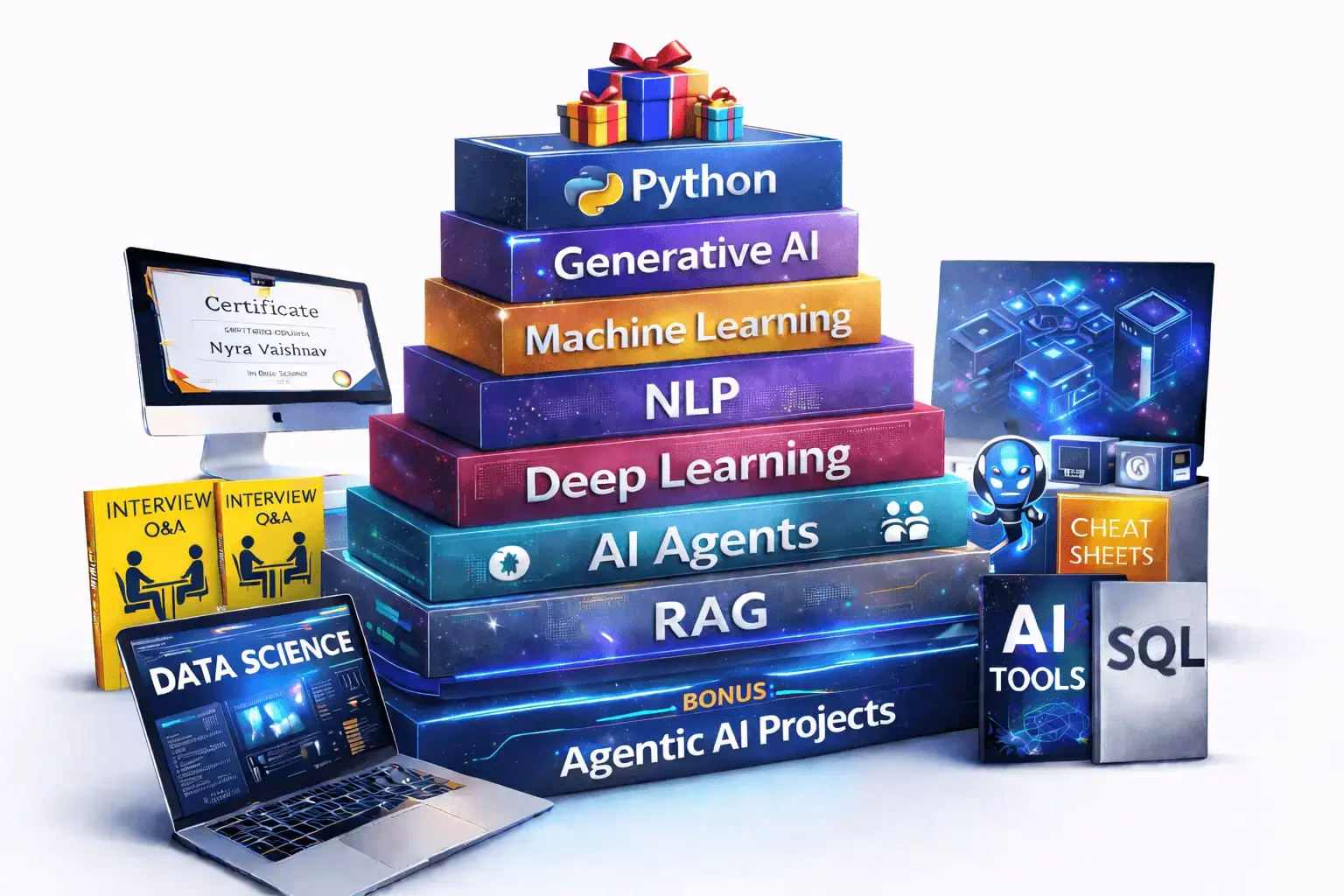
Here's everything you're going to get
- 100% Guaranteed Placements
- Live Capstone Projects
- Study Materials
- Tutorials
- Interview Q&A Library
- Mock Interviews
- Access to Private Jobs Group
INSIGHTS


