
If you’ve worked with data even for a short time, you’ve probably noticed something.
The challenge isn’t getting data anymore. Most companies already have more than enough of it.
The real bottleneck is turning that data into something usable quickly.
And that’s where things have started to shift.
Earlier, analysts spent a lot of time:
- cleaning datasets
- writing queries
- building dashboards
- manually interpreting results
That hasn’t disappeared. But the way it’s done is changing.
In 2026, AI tools are quietly becoming part of the workflow not as replacements, but as accelerators.
If you talk to analysts working in Mumbai right now, especially in startups and consulting environments, you’ll hear a similar pattern:
“The work is still the same. It just takes less time.”
Let’s look at the tools driving that shift.
1. ChatGPT (For Data Exploration and Explanation)
This is probably the most widely used tool even outside technical roles.
But in analytics, it’s being used in more specific ways.
Where it helps:
- explaining datasets
- generating SQL queries
- summarizing insights
- translating technical output into simple language
Instead of spending time figuring out syntax or writing explanations, analysts use it as a support layer.
Real example:
You paste a dataset description → get:
- possible analysis approaches
- query suggestions
- summary insights
It doesn’t replace analysis but it speeds up the process.
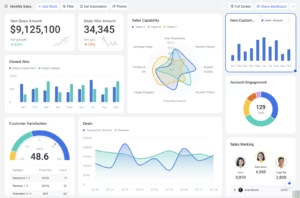
2. Microsoft Power BI with AI Features
Power BI itself isn’t new. But the AI layer added to it is changing how dashboards are used.
Instead of static visuals, you now have:
- natural language queries
- automated insights
- anomaly detection
Practical impact:
- less manual chart creation
- faster pattern recognition
- easier reporting
For many learners, this is where structured Data Analytics Training becomes useful because understanding how to combine dashboards with AI features requires more than just tool familiarity.
3. Google BigQuery + AI (For Large-Scale Data Processing)
When dealing with large datasets, performance becomes critical.
BigQuery, combined with AI capabilities, allows analysts to:
- process massive data quickly
- run predictive queries
- integrate machine learning models
Where it stands out:
- speed
- scalability
- handling complex queries
This is more common in larger companies or data-heavy environments.

4. Tableau with AI (Explain Data & Predictions)
Tableau has introduced features that:
- explain trends automatically
- highlight key drivers
- generate predictions
Instead of manually analyzing charts, you get:
- suggestions
- explanations
- insights
This reduces time spent on interpretation.
What’s Actually Changing in the Workflow
The tools are different but the bigger change is in how work is approached.
Earlier:
more time on execution
Now:
more time on interpretation
AI handles part of the groundwork.
Analysts focus on:
- decision-making
- communication
- context
Why This Matters in Mumbai’s Job Market
Mumbai has a mix of:
- startups
- consulting firms
- enterprise companies
All of these environments value speed.
If you can:
- analyze faster
- explain clearly
- deliver insights quickly
you stand out.
Skills That Matter Now
Tools alone aren’t enough.
You still need:
- data understanding
- analytical thinking
- communication skills
But now, you also need:
- ability to use AI tools effectively
Many learners build this combination through Data Science Training, where both technical and practical aspects are covered together.
Common Mistakes Beginners Make
1. Relying Too Much on Tools
AI helps but doesn’t replace thinking.
2. Ignoring Fundamentals
Without basics, outputs don’t make sense.
3. Trying Too Many Tools
Better to learn a few properly.
A Subtle Shift in Expectations
Earlier, knowing tools was enough.
Now, employers expect:
- faster execution
- better interpretation
- practical application
Future of Data Analytics Jobs
This space is evolving.
Expect:
- deeper AI integration
- less manual work
- more focus on insights
But one thing won’t change:
The need for human judgment.
Conclusion
AI tools are not replacing data analysts.
They’re changing how analysts work.
Less repetitive effort.
More meaningful analysis.
Faster decision-making.
For anyone entering this field especially in a competitive environment like Mumbai understanding these tools isn’t optional anymore.
It’s becoming part of the baseline.